Building Production-GradeMeeting Intelligence
An AI-native platform designed around operational reality — long-running pipelines, asynchronous orchestration, multi-tenant collaboration, and searchable institutional memory.
Year
2026
Role
Product Engineer
Scope
AI Systems, Full-Stack Architecture, Infrastructure, Product Design
Most meetings get recorded. The real problem begins afterward — decisions disappear into recordings, action items scatter across tools, and teams revisit conversations they already had.
What does it actually take to build AI systems people can operationally depend on?
Lume was my attempt to answer that question — not by prompting a model and generating summaries, but by designing the full system around it: ingestion, processing, retries, collaboration, search, and reliability.
Product Surface
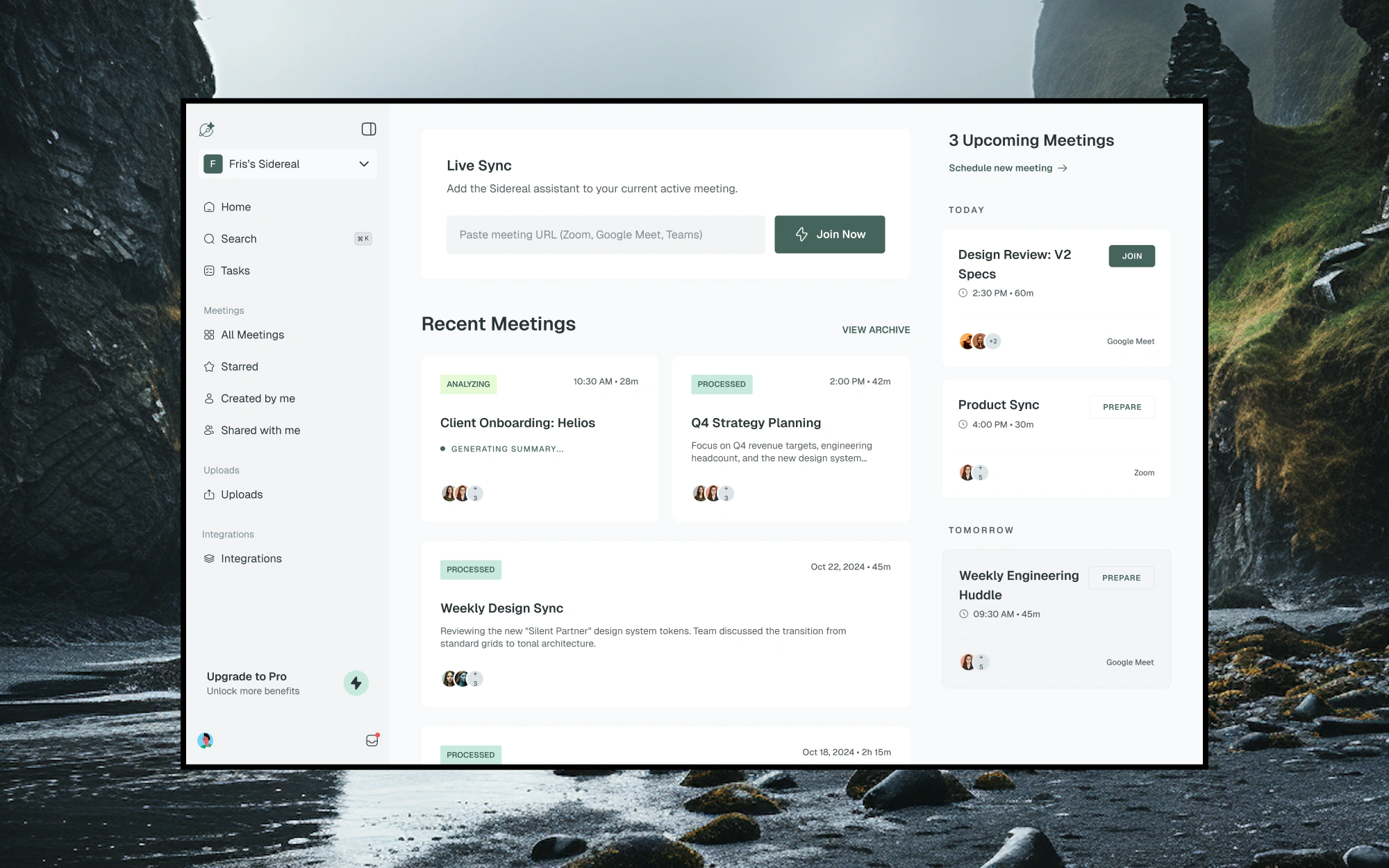
Rather than treating meetings as isolated recordings, Lume treats them as evolving organizational knowledge.
Capture
Zoom, Google Meet, or Teams via live sync. Manual audio/video uploads.
The product is not about transcription. It's about turning conversations into searchable organizational memory.
Design Principles
P — 01
AI output should remain editable
Meeting documents are powered by TipTap. Teams can fix incorrect terminology, clarify decisions, evolve notes over time. AI systems make mistakes — the product should support correction, not hide it.
P — 02
Collaboration is not a future feature
Workspaces, permissions, sharing, invites — built from day one. Owner, admin, member, and guest roles. Meeting knowledge is inherently team-scoped; collaboration infrastructure cannot be retrofitted.
P — 03
Search must support both recall and intent
Keyword-only search fails for conversations. Semantic-only fails when users know exact terminology. The hybrid approach — pg_trgm plus embeddings — was the only adequate answer.
P — 04
Slow systems must still feel responsive
Transcription takes minutes. BullMQ background jobs, Redis pub/sub, and SSE keep the interface continuously informed. Perceived responsiveness often matters more than raw speed.
Designed forlong-running workloads
Lume is structured as a pnpm + Turborepo monorepo with four independently scalable runtime surfaces.
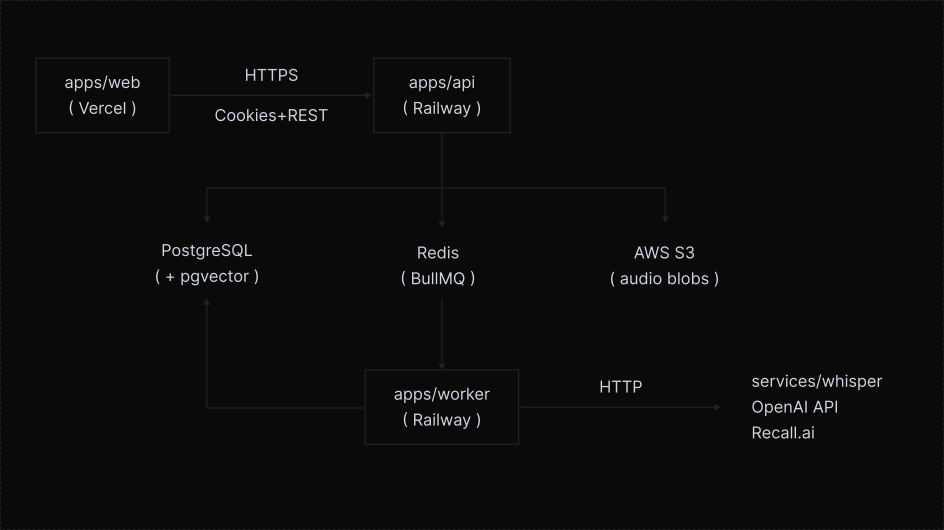
FRONTEND
Next.js 16
apps/web — UI delivery, rendering, client interaction
BACKEND API
Fastify 5
apps/api — Long-running requests, webhook handling
WORKER SYSTEM
BullMQ
apps/worker — Queue orchestration, retries, failure handling
ML SERVICES
faster-whisper + pyannote
services/whisper — GPU transcription, speaker diarization
STORAGE & SEARCH
PostgreSQL 16 + pgvector
Hybrid retrieval: pg_trgm exact match + semantic embeddings
INFRASTRUCTURE
Redis · AWS S3 · Recall.ai · OpenAI
Pub/sub, object storage, bot transcripts, LLM analysis
Key Technical Decisions
Decision
Separate API runtime
Problem
Meeting processing can run for minutes. Serverless environments are optimized for milliseconds — they impose hard timeout constraints on long-running work.
Outcome
Fastify runs independently. No serverless timeouts. Reliable webhook handling. Independent deployment surfaces.
Decision
BullMQ orchestration
Problem
Transcription, diarization, embeddings, and analysis must never block user-facing requests — but each stage has different failure modes and retry needs.
Outcome
Upload endpoints stay fast. Each queue stage runs independently with its own retry logic. Failures become observable, not invisible.
Decision
Dual ingestion paths
Problem
Recall.ai already provides transcripts for live meetings. Running Whisper again wastes GPU time and adds latency without improving quality.
Outcome
Bot meetings skip directly to analysis queues. Uploads use the full GPU pipeline. Lower cost, faster processing, better scalability.
Decision
SSE over WebSockets
Problem
Users cannot stare at a static loading screen for minutes. But WebSockets introduce socket management complexity and sticky-session requirements.
Outcome
Redis pub/sub + Server-Sent Events deliver realtime pipeline progress without the operational overhead of a persistent socket layer.
What was Shipped
Production-ready AI pipeline architecture
Multi-runtime orchestration system
Realtime processing infrastructure
Multi-tenant workspace collaboration
Hybrid keyword + semantic search
Recall.ai bot ingestion path
Editable TipTap meeting documents
SSE pipeline progress streaming
Linear and Slack action integrations
Reflection
“Good AI products are rarely about adding more intelligence. They're about reducing friction, clarifying information, and helping people make better decisions faster.”
Lume became a systems engineering exercise in reliability, orchestration, infrastructure thinking, and operational product design — built solo, end-to-end, from first principles.
Previous
RelayRead Next Case Study
SVJ Outdoor